
For businesses that plan shifts and have to prove them
Securo Hub is built for service businesses — wherever staff work in shifts, are deployed at customer sites and the company has to show who was where, and for how long. It goes furthest in the security industry: that is where it brings modules no standard HR system has.
Less a question of industry than of how you work
What it says on your sign tells you little about whether a piece of software fits. These four points do. If three of them describe your business, a conversation is worth it — even if your industry is not on the list below.
Work runs in shifts
Early, late, night, weekend, public holiday. Plans change at short notice, and every change has consequences all the way into payroll.
Deployment at other people's sites
Your people work at the site, at the customer or on the road — not at a desk in your back office.
Proof owed to third parties
Customers, authorities, auditors or insurers ask: who was on duty, for how long, with which qualification? The answer has to be verifiable.
Administration without an IT department
Scheduling, HR and invoicing sit with a handful of people, often on the side. What eats time is re-entering the same data across tools.
Security services: the whole operation, not just the roster
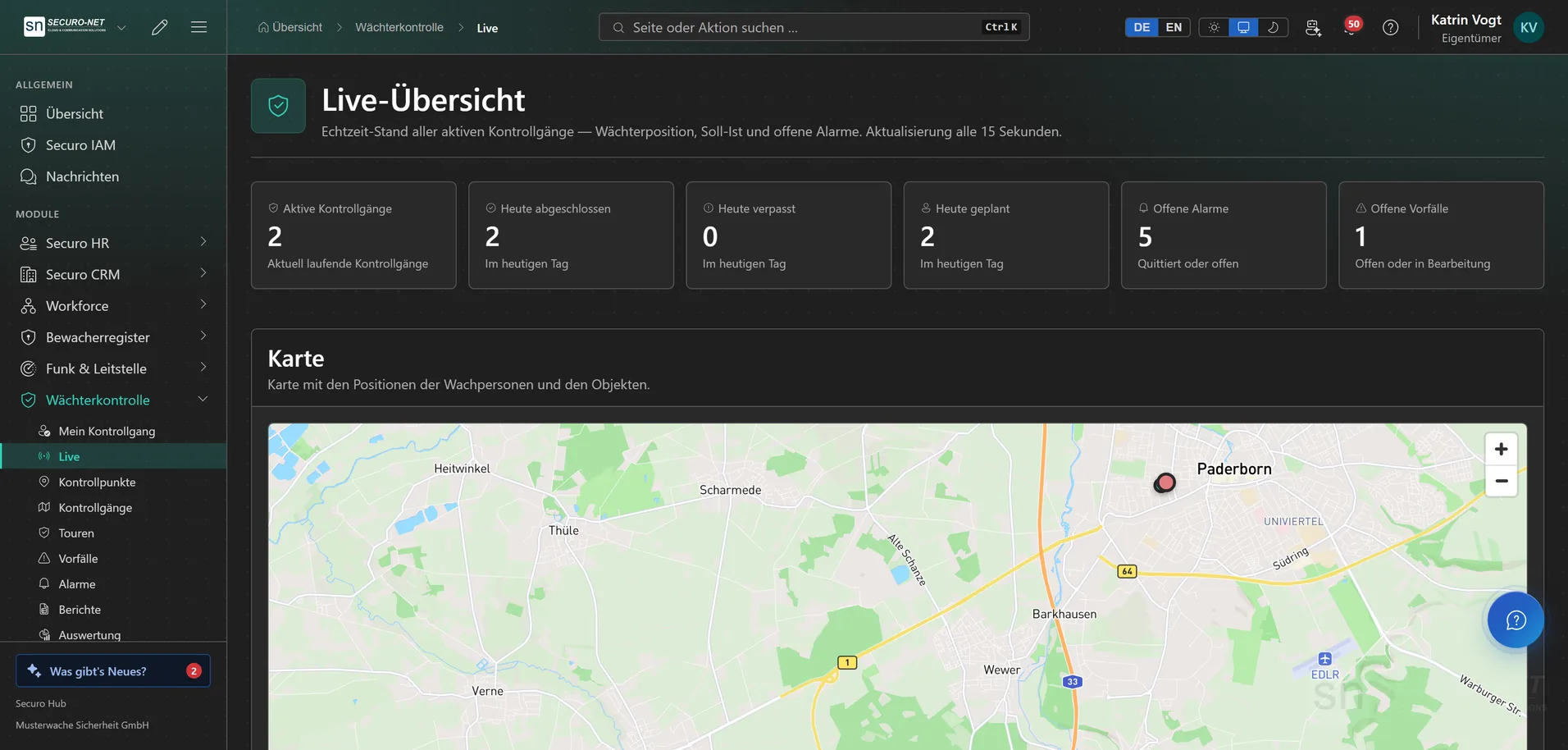
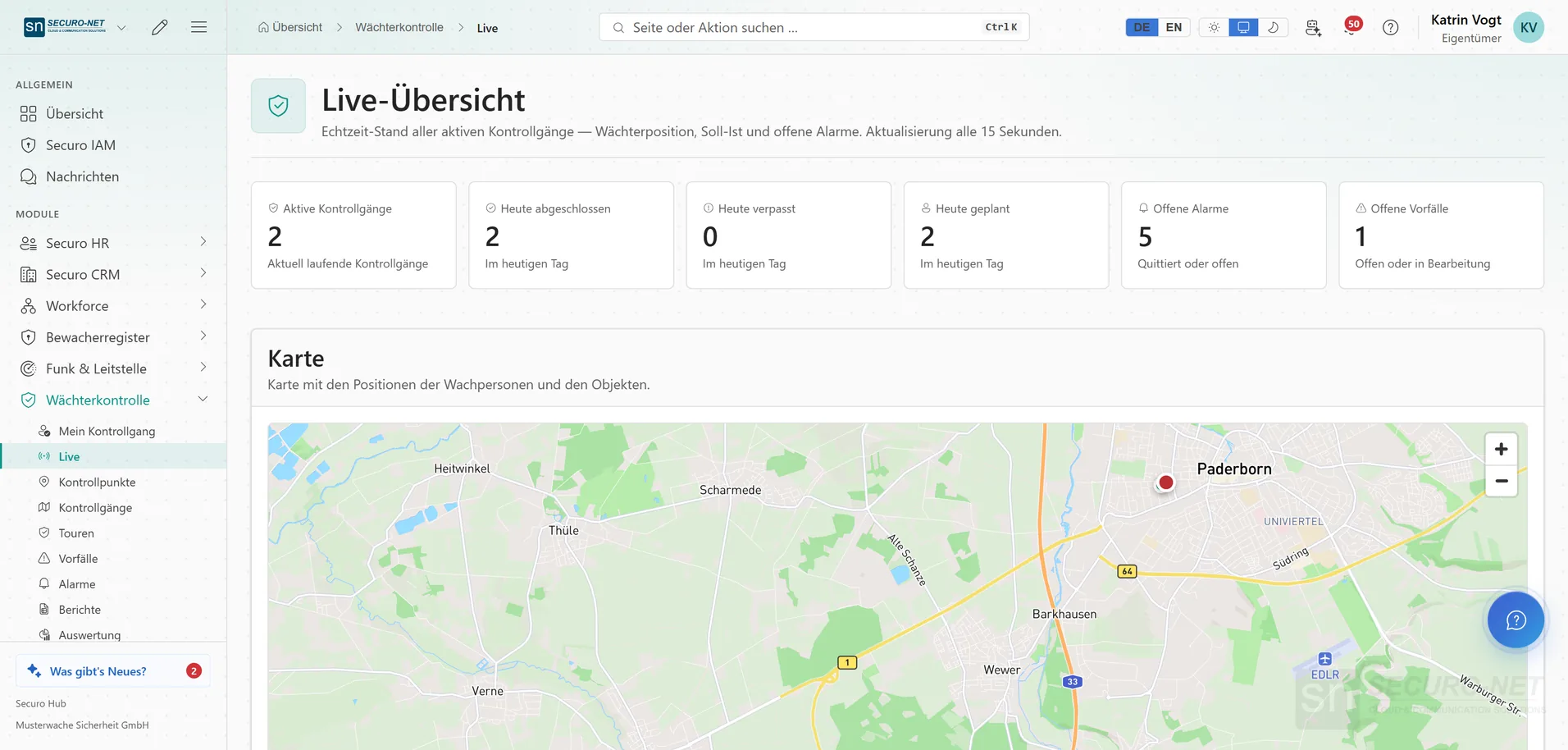
Securo grew up in the security industry, and it shows. Alongside scheduling, time tracking and payroll preparation, the Hub carries the modules standard HR software does not know: the Bewacherregister, a digital duty log, GPS lone-worker protection and dispatch radio — on the same master data as everything else.
Bewacherregister and § 34a
Guard IDs, proof of qualification and expiry dates live in the employee record, and you see your guards' register status in the Hub. Expiring certificates stand out before they become a problem.
A duty log written on the job
Incidents, patrols and handovers are captured on mobile — instead of being reconstructed at month's end when someone asks.
Patrol, dispatch, lone workers
OWKS checkpoints, GPS and PTT radio hang off the same roster. Dispatch sees who is where, without a second system.
Site managers see their site
Permissions follow the location. A site manager plans and checks the shifts of their own sites — and sees nothing else.
Modules in use
Workforce · OWKS · PTT · Bewacherregister · Duty log · HR
Other industries the Hub fits
The same pattern everywhere: many people, changing locations, hard documentation duties. What differs are the rules behind them — and those sit in the modules, not in a checklist.
Facility & building services
Schedule cleaning and building-technology teams across many sites, evidence the work done per site and bill by actual hours instead of a flat rate.
Care & healthcare
Three-shift operation with qualifications and training deadlines, rest periods under the German Working Hours Act, and employee data in a system built for GDPR from the ground up.
Hotels & restaurants
Short-notice changes, casual staff and mini-jobs, night, Sunday and holiday premiums — calculated the moment the hours are recorded.
Logistics & warehousing
Plan driver and warehouse shifts, record time on mobile, keep working-time limits in view and bill per tour, job or customer.
Staffing & temporary work
Plan people across several client assignments, record hours per site, and produce client billing and payroll preparation in one pass.
Events & stewarding
Large teams for a few days, last-minute confirmations and drop-outs, admission and steward duties with name lists and proof — instead of spreadsheets and group chats.
Trades & technical service
Schedule fitters and service technicians, record working time against the job, and carry those hours straight into billing.
SMEs in general
Shift work or not: personnel files, contracts, leave, time tracking and invoicing in one system instead of five tools that know nothing about each other.
Compliance is not an industry topic
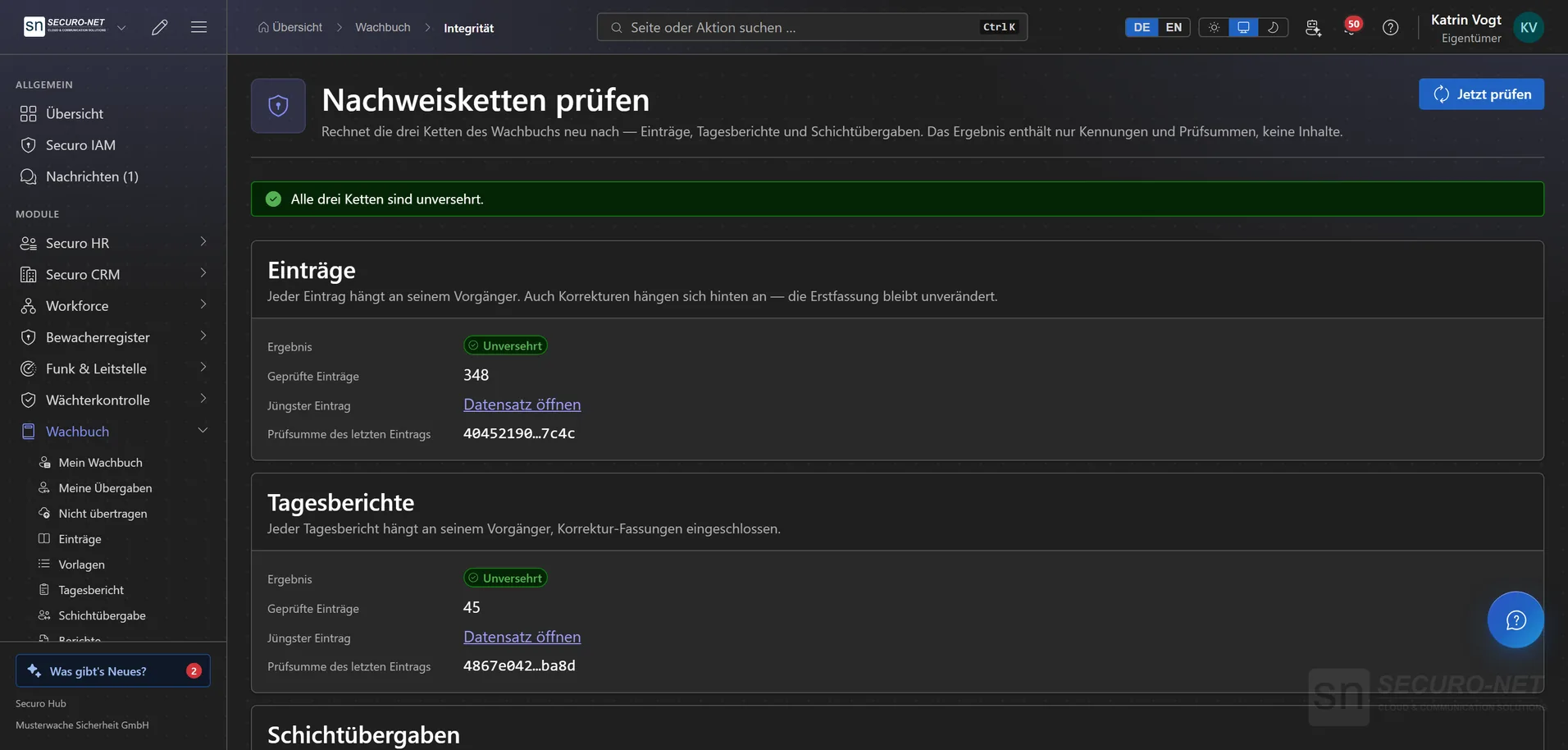
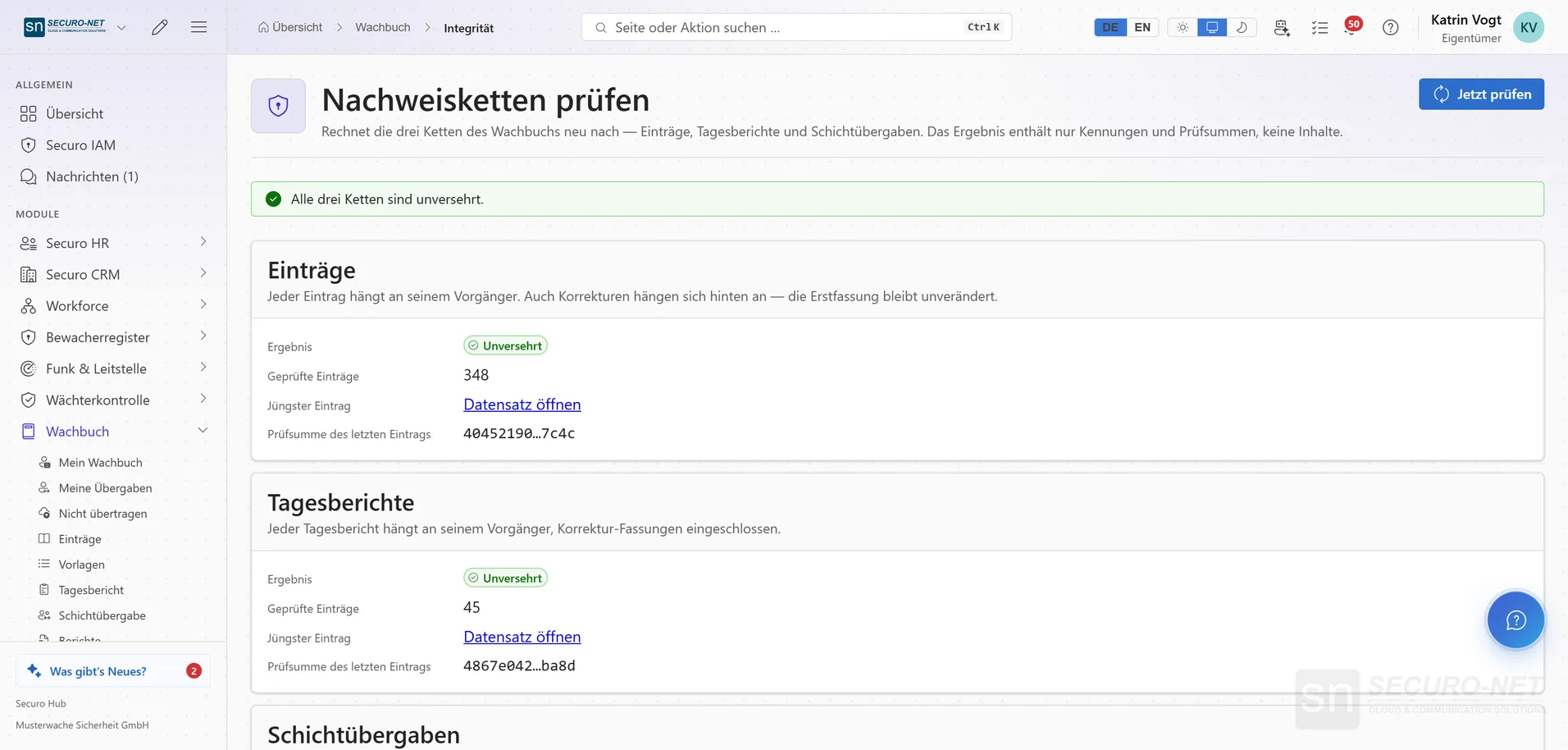
The duties differ less than people expect: working time must be recorded, rest periods observed, employee data protected and records kept traceable — in guarding just as in care. In the Hub the system checks while you plan, instead of someone recalculating while they bill.
Working time & rest periods
The roster checks rest periods and mandatory qualifications as you assign; breaks, the daily limit and the 24-week average under the ArbZG surface in the approvals. Breaches show up before billing, not afterwards.
Duty to record hours
Every hour is recorded, breaks included. Later corrections stay traceable, with a reason attached.
GDPR & EU hosting
Employee data stays in the EU, access follows roles, and access or deletion requests can be answered without a database export.
Invoicing & DATEV
Gap-free number ranges, e-invoicing and DATEV posting batches for your accountant. Payroll export directly for DATEV Lohn & Gehalt, for other programs such as LODAS as CSV or your own template.
In the security industry, § 34a GewO and the Bewacherregister come on top — both in the product, not in the manual.
Your industry not on the list?
Then tell us in half an hour how you plan, record and bill. We will tell you whether the Hub fits — and where it does not.